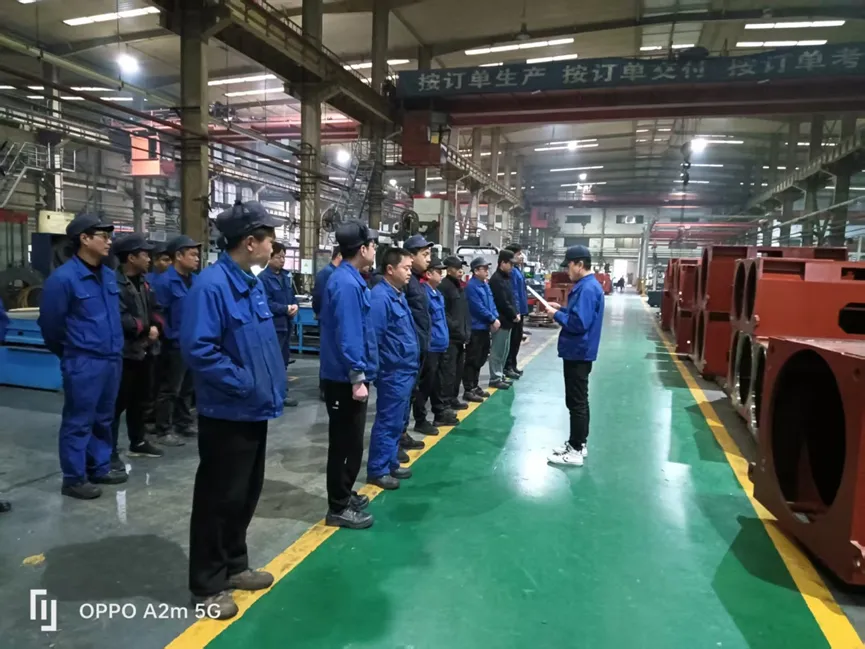
In order to regulate the entire production process of controlling permanent magnet motor rotors and effectively prevent quality risks such as magnetic attraction, shock, contamination and other defects during transportation and storage, at the morning meeting on March 30, all teams of the mechanical processing workshop conducted a targeted study of the document “Rules for Transportation and Storage of Permanent Magnet Motor Rotors” (GY3-2851). Technical requirements were communicated to each primary production workplace in full and with high accuracy.
At the training site, the leaders of all teams examined in detail the main points of the technical information sheets, taking into account real production examples of rotor manufacturing. Key issues were explained step by step: protection during transportation of cores, standards for installing magnets, requirements for protection during press assembly, management of transportation and storage of finished products, as well as safety during loading-unloading and transport operations.
All technological nuances were considered: laying and protective coating of pallets after assembling individual sections of the core, rules for using clean tools when installing magnets, wrapping open sections of the shaft with foam material, as well as storing finished rotors on specialized pallets and reusing them. Each operational detail has been detailed and highlighted, allowing staff to fully understand current regulatory requirements.

All training participants, dressed in uniform work clothes, listened carefully to the presentation and took detailed notes, as well as exchanged opinions and discussed issues arising in everyday work.
Employees noted that they will strictly carry out all technological operations in accordance with the new rules, implement quality control at all stages of rotor production and prevent damage to products due to - improper transportation and storage already at the early stages of the production process.
This training not only strengthened the awareness of process compliance among primary production personnel, but also reliably strengthened the first line of product quality for permanent magnet motors.
In the future, the machine shop will continuously strengthen controls and inspections, ensure full and effective implementation of transportation and storage regulations, and guarantee stable, high-quality production at the enterprise.