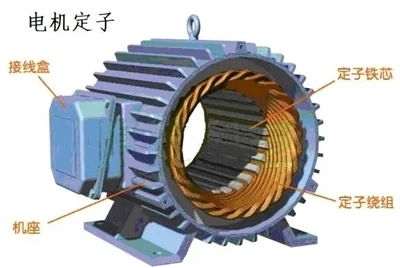
Compared to horizontal motors, vertical motors, especially large ones, have a special bearing system that uses angular contact ball bearings at one end. Due to-the unique design of angular contact ball bearings, it is imperative that the bearings are never installed in the reverse direction, as this will cause immediate failure. If the bearings are not installed correctly or if they become axially misaligned while the engine is running, it may cause abnormal vibrations and unusual noises.

Noise problems in vertical motors
Vertical motors, especially large ones, feature a special bearing design that is often equipped with angular contact ball bearings at one end. This precision bearing design can be damaged if incorrectly oriented during assembly. In addition, improper bearing installation or axial displacement during engine operation may cause abnormal vibration and noise.
Single row angular contact ball bearings are specifically designed to withstand combined loads, allowing them to withstand significant axial forces in one direction. In vertical motors, these bearings are typically used at the non-shaft extension end to handle axial forces that exceed the load capacity of deep groove ball bearings. Their dimensions are compatible with the corresponding single row radial bearings used in the engine, avoiding potential problems encountered in redesigning the design.
The use of angular contact ball bearings in vertical motors allows them to withstand significant axial forces and maintain a balanced position between the rotor and stator. In such applications, these bearings are usually installed in pairs to meet different operating requirements. By strategically positioning the bearings, an axial force can be applied to counterbalance the weight of the motor rotor, resulting in a stable axial relative position between the rotor and stator.
Both support and suspended configurations of angular contact ball bearings present their own challenges during engine operation. In particular, any axial movement or vibration may cause unstable operation and noise. In addition to axial dimensional matching, after power is applied, the magnetic centers of the stator and rotor spontaneously align under the influence of electromagnetic force.
When it comes to choosing a motor bearing configuration, several measures can be taken. These include the use of paired angular contact ball bearings to effectively control axial displacement, the use of a three-bearing design to improve stability, and the implementation of adequate pre-displacement between the stator and rotor. However, it is important to note that the amount of pre-displacement must be controlled within acceptable limits to avoid adverse effects. In addition, during storage, transportation and testing of vertical motors, the unit must be maintained in the correct vertical position to prevent damage to the bearings due to improper exposure to external forces.
Vibration problems in large vertical motors
We will now focus on vibration problems in large vertical pump motors. Such engines typically have significant cylinder bearings and overall height, operating at around 1500 rpm. Top bearings typically use plain or antifriction bearings; however, sliding bearing vibration problems are typically associated with guide bushing adjustments and are therefore beyond the scope of this discussion. We will focus on vibration problems in engines with bearings in the upper position, the design of which includes the engine, cylinder support, pump housing and inlet/exhaust piping.
The vibration amplitude is maximum at the top of the engine and gradually decreases downwards with a clear directional pattern. During dry motor testing, when the motor is connected to the support housing but not to the pump rotor, the dominant vibration frequency is the same as the rotation speed. However, after connecting the motor to the pump rotor, the dominant frequency may shift by up to 2X.
Engine vibration gradually decreases with altitude, exhibiting directional characteristics. The vibration frequency may change significantly after connecting the motor to the pump. For example, motor vibration problems can be caused by several factors: excessive vibration during initial commissioning, after a motor replacement or repair, or persistent vibration despite the pump rotor being turned off during operation.
Engine vibration can come from several sources, including the engine itself, the support cylinder, the pump housing, and the intake/exhaust lines.
Engine vibration can be caused by various internal factors. Insufficient balancing accuracy is a critical problem, especially in support cylinder systems coupled with a motor where the overall stiffness is low. Even a slight imbalance can cause significant engine vibration. However, reducing imbalance is often effective in mitigating vibration. In addition, improper bearing installation often contributes to engine vibration. For example, when the top bearing carries the load and the bottom bearing provides support and direction, the rotor remains suspended. This explains why the top bearing is often the first to fail. Checking the load distribution on both bearings can prevent such problems.
Insufficient rigidity of the support structure can cause vibration problems. When a motor is connected to a support structure, its inherent rigidity limitations gradually become apparent. To determine whether the problem - is in the engine or the support structure, separate tests can be performed on a test bench: one with the engine alone, and another with the engine and support structure together. At the same time, the impact can be reduced by strengthening the support and applying adjustment techniques.
Structural resonance in some engines can significantly affect vibration levels. Field tests show that resonant frequencies can affect operation over a range of ±160 rpm, sometimes directly affecting the rated speed. In such cases, experimental verification and improvement of motor accuracy are necessary to reduce vibration. Structural resonance can have a significant effect on engine vibration; Experimental confirmation and improvement of engine precision are needed to reduce this effect.
When solving vibration problems, it is necessary to comprehensively take into account various factors and take targeted measures. These may include improving balancing accuracy, ensuring overall vertical alignment, adjusting bearing clearances, adding temporary supports, and redesigning the drum support structure. When implementing temporary support measures, it is necessary to ensure that the support points are located at the top of the engine and the support force is adjusted accordingly to achieve a significant reduction in vibration.