An electric motor is a complex mechanical device and its design and construction are varied, but most electric motors contain some basic and commonly used components. Below is a systematization of commonly used electric motor components:
1. Stator part
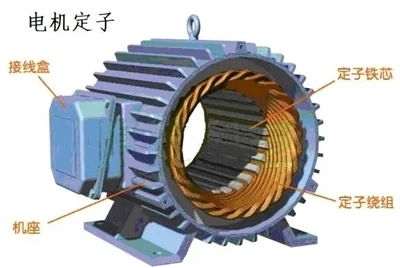
Stator core
Typically made from electrical steel (silicon steel) stacks to reduce eddy losses. The stator core is the stationary part of the electric motor, designed to create a magnetic field; its main function - is to support the stator winding and form a magnetic circuit.
Stator winding
It consists of conductors (copper or aluminum wires) wound into the grooves of the stator core, and is designed to create a magnetic field. The stator winding is a key component of an electric motor, and its performance directly affects the performance and efficiency of the entire electric motor.
2. Rotor part
Rotor core: Also made of laminated silicon steel sheets. It is similar to the stator core, but is the rotating part of the motor.
Rotor winding: varies depending on the type of motor. The rotor windings of some motors (such as induction motors) are squirrel-cage or squirrel-cage windings, while the rotor windings of some motors (such as synchronous motors or DC motors) are coils wound on the rotor core.
3. Support and transmission part
Bearing: Supports the motor shaft, reduces shaft friction and ensures smooth rotation of the rotor. The bearings can be rolling bearings or plain bearings. Rolling bearings are standardized and serialized and are widely used in various types of engines.
Shaft: The component that connects the rotor to external equipment and is used to transmit torque. Shaft material and design depend on load and speed.
End caps: Attached to both ends of the stator to protect internal components and prevent foreign objects from entering. This also helps maintain the structural integrity of the engine.
4. Electronics and control part
Brushes: Made of conductive material, they slide across the commutator to provide electrical current. The brush material must have good electrical conductivity and wear resistance.
Commutator: A mechanical component used to automatically change the direction of electrical current as the motor rotates. The commutator consists of several commutator segments in contact with the brushes.
Connection box: The electrical connection part of the motor, used to access the power and control circuit. The junction box usually contains terminal blocks and protective devices.
5. Cooling and protection part
Fan: Used to cool the engine to prevent damage due to -overheating. Fans can be built-in or external, depending on the cooling needs of the engine.
Radiator: Some engines use radiators to increase the heat dissipation area and improve heat dissipation efficiency.
Protective Devices: Such as overload protection devices, short circuit protection devices, etc., used to protect the motor from damage.
6. Other commonly used accessories
Commutator Rings: A component of a generator or electric motor used to transfer electrical current from a rotating part to a stationary part.
Coils: Wire wound around a stator or rotor core to create a magnetic field or carry current.
Casing: The outer protective shell of the motor, usually made of metal or plastic, used to protect against dust, noise, water, etc.
Fan Cover: A shroud installed on the outside of a fan to direct airflow and protect the fan blades.
Additionally, there are some specific types of motors (such as stepper motors, servo motors, etc.) that may require some special accessories such as encoders (used to provide feedback signals about the speed and position of the motor), couplings (used to connect the motor shaft and the load shaft), brakes (used to control the rotation of the motor), etc.
To summarize, there are many types of common engine accessories and they vary depending on the engine type and application requirements. When selecting and purchasing engine accessories, the choice should be based on the specific needs and specifications of the engine.